Humanitarian aid in Mozambique: our response to the crisis
We have been working in Mozambique since 2000, supporting communities that face complex challenges every day and are building their future with determination.
Over the years, we have expanded our activities to respond to an increasingly complex context, working with local organisations, communities and public institutions, whilst maintaining a constant focus on conflict, gender equality and the active involvement of young people.
The emergency in Mozambique
Mozambique is experiencing a convergence of crises. The situation in Cabo Delgado, marked by a conflict that began in 2014 and is still ongoing, continues to cause displacement, service disruptions and serious protection risks for the civilian population. Repeated evacuations, such as those from Chiúre in July 2025 and Mocímboa da Praia in October 2025, have made access to humanitarian aid and the continuity of services even more challenging.
Along this crisis are increasingly frequent extreme weather events such as cyclones, floods and droughts, which repeatedly affect harvests, homes and essential infrastructure. For many families, this means the loss of livelihoods and food insecurity, in a cycle that repeats itself year after year.
These vulnerabilities are exacerbated by structural factors such as youth unemployment, the fragility of education systems and gender inequalities, which are more pronounced in rural areas. In the most remote districts, access to basic services such as healthcare, education and protection remains limited and is often sporadic.
What we do in Mozambique
We operate in the country’s hardest-hit areas, particularly in Cabo Delgado and the province of Tete, with coordination at national level from Maputo. Our work is based on an integrated approach that combines education, protection, livelihood support and climate action, as the crises affecting communities are deeply interconnected.
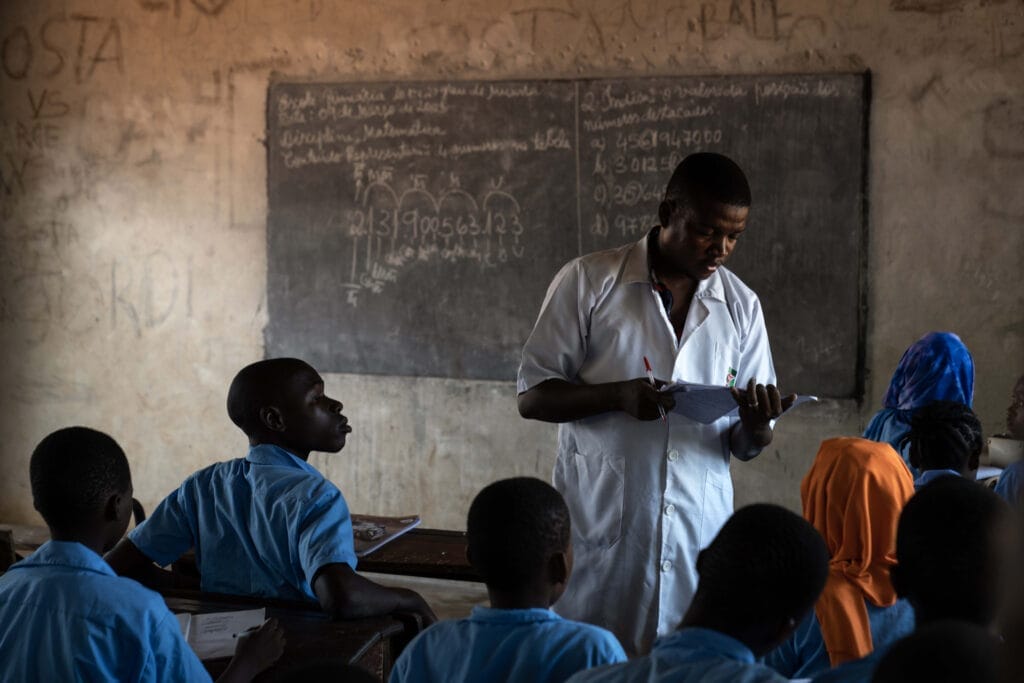
In the education sector, we work to ensure continuity of learning even during emergencies, by rehabilitating schools, training teachers and setting up catch-up programmes that enable children and adolescents to continue their education without interruption. At the same time, schools also become spaces of protection and participation for the younger generation.
On the protection front, we take action to prevent and respond to gender-based violence, strengthening safe spaces for women and girls, support services and referral pathways, in collaboration with local women’s organisations working directly within communities.
We also support families in strengthening their economic self-reliance and climate resilience by promoting more sustainable farming practices, access to markets, and tools to cope with environmental shocks. In times of acute crisis, our work focuses on providing an immediate response to displaced people and maintaining essential services.
All our work is underpinned by a constant commitment to social cohesion and peacebuilding, through dialogue between communities and the involvement of people in processes of reconstruction and change.

The crisis as told by those living through it
Gathering the voices and stories of the communities we work with is central to our work and allows us to understand crises from the inside.
The Women See Many Things project involved young women aged between 18 and 30 along the Swahili coast stretching from Kenya to Tanzania and Mozambique. Through photography, the participants in this project have recounted their daily lives and the meaning of peace in their communities. The images also illustrate the impact of gender-based violence and show how the conflict in Cabo Delgado has exacerbated displacement and vulnerability. The result is a direct and powerful account that highlights the human cost of crises and the central role of women in peacebuilding.
Through the Africa Blues photography project by photographers Giulia Piermartiri and Edoardo Delille, we documented climate change in Mozambique through images that juxtapose today’s daily life with possible future scenarios. The photographs imagine how these same places might look in 2100, concretely illustrating the effects of the climate crisis on rural communities. The works, created by Piermartiri and Delille following a period spent in the field with our team, stem from listening directly to people and convey a sense of a future that is not far off but already taking shape.


