Join the movement for menstrual justice: promote rights, break down stigma and raise awareness about menstrual health and poverty.
Water is the essence of life. It is not a privilege, but a fundamental universal right for all. Everyone—women, men, and children—needs access to clean, safe water to live with health, dignity, and equality.
Yet the water emergency is now one of the most serious global crises: more than 2 billion people lack access to drinking water. One in ten people are forced to live without this essential resource, and one in five children die before reaching the age of 5, precisely because of the lack of clean, safe water.
With our Flowing Futures Atlas, we explore in depth the link between safe water, health and well-being, showing how access to water and sanitation services is the basis for other fundamental rights: education, work, food, housing and sustainable development.
Clean water, a primary good for everyone
Guaranteeing the right to water is one of the fundamental pillars for protecting human rights and, consequently, ensuring that everyone can thrive; a commitment that must involve the entire international community.
At WeWorld, we operate in complex and fragile contexts, from Syria to Lebanon, Kenya to Ukraine, with interventions that ensure not only access to clean drinking water, but also adequate education on its sustainable use.
In situations of conflict, prolonged crises or extreme weather events, our water projects translate into concrete actions to protect people's health, safety and dignity. We work every day to strengthen communities through lasting, adaptable and participatory solutions.
World Water Day, celebrated every 22 March, shines a spotlight on how essential this resource is to life. It is also an opportunity to renew our collective commitment to protecting a resource that cannot be taken for granted. Our goal is to make a concrete contribution to achieving the sixth goal of the 2030 Agenda, to ensure that all people, everywhere in the world, have access to sanitation and a clean and sustainable water supply.
Because water is a right, not a privilege.
Our work to ensure access to clean drinking water
The lack of clean drinking water is a global emergency affecting millions of people around the world, particularly children. In many communities, the lack of access to these fundamental right compromises people's health, access to education, safety and future.
Through our projects, we work every day to ensure safe, equitable and inclusive access to clean water, especially in areas affected by conflict, humanitarian crises and climate change.
Through our WASH (Water, Sanitation and Hygiene) interventions, we build and rehabilitate water infrastructure.
We intervene in contexts where the lack of clean water is most acute – such as in Lebanon, Ukraine and Gaza, where people are forced to leave their homes due to ongoing conflicts and where infrastructure has been destroyed, or following emergencies such as the earthquake in Syria – to respond promptly to people's basic needs.
We work together with communities and local authorities, the main agents of change, to promote sustainable practices that are sensitive to each context. Every day, we work with our colleagues to ensure access to clean water and sanitation services, so that all people can live with dignity, even in the most critical contexts
Our intervention from the Gaza Strip to Ukraine
In the Gaza Strip, the destruction of water infrastructure has left hundreds of thousands of people without access to clean water.
Through our projects, we intervene by providing clean water via tankers, responding to the most urgent needs of families.
We also promote the creation of local committees, with the aim of spreading good hygiene practices, adapted to the emergency context, and strengthening the resilience of communities.
In the West Bank, in addition to distributing clean water by tanker truck to refugee camps, we implement innovative and sustainable solutions to the water crisis.
These include the reuse of treated wastewater in agriculture and the installation of solar water pumping systems.
These interventions not only guarantee access to a fundamental resource, but also promote the sustainable management of natural resources and the autonomy of communities.
The conflict in Ukraine, like the crisis in Syria, has damaged water infrastructure, leaving much of the population without access to water. In recent years, our efforts have focused on the rehabilitation and long-term maintenance of the water network and pumping stations to restore them to proper functioning.
In Ukraine, this work has included hospitals and health facilities, while in Syria it has also included schools to ensure access to health and education.
The impact of water scarcity on the lives of women and children
When clean water is scarce, it is often women and girls who pay the highest price. In Ukraine and Palestine, due to ongoing conflicts, women and girls face threats to their safety, health and dignity. The lack of sanitation facilities, unlocked doors and lighting also increase the risk of sexual violence. In addition, the shortage of essential personal hygiene products, such as menstrual products, further exacerbates the situation.
Similar circumstances also occur in Mozambique, Kenya and Tanzania, where water supply is often the responsibility of children and women. On long journeys to collect water, women and girls are exposed to the risk of violence, particularly in isolated or unprotected areas.
Even within schools, access to water and sanitation facilities is still too often inadequate.
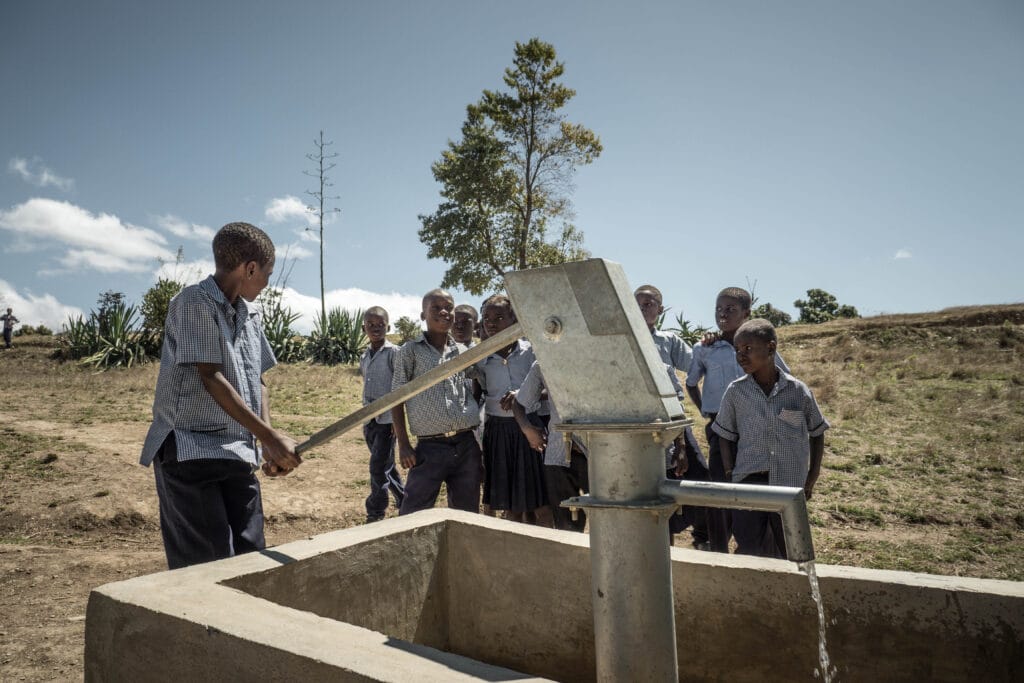
At WeWorld, we are committed to providing schools with clean water tanks, which are essential for hand washing, using sanitation facilities and preparing healthy meals. Every school kitchen must have a water point to ensure that classes can have one quality meal a day.
In addition, we build inclusive sanitation facilities accessible to all, including those with disabilities, and distribute hygiene kits, so that schools are safe environments where children are safe and free to study and learn.
The importance of raising awareness of good hygiene practices
Ensuring access to clean water is only one part of our work. It is equally important to promote awareness and the adoption of good hygiene practices, especially in the most vulnerable contexts.
At WeWorld, we work in schools and communities to raise awareness of the importance of handwashing, a simple but essential gesture for preventing infections and diseases such as cholera.
In addition to building adequate infrastructure and sanitation facilities, we distribute hygiene kits and promote healthy and environmentally friendly behaviours. Our commitment extends to homes, schools, workplaces and public spaces, so that everyone, at every stage of life, can live in healthy and safe environments.