
The invisible risk shaping daily life and the future of children
More than four years after the escalation of large-scale warfare, Ukraine is now the most heavily contaminated country in the world with landmines and unexploded ordnance. It is estimated that around 30% of the territory - equivalent to 174,000 square kilometres - is potentially contaminated. Since February 2022, more than 1,300 people have been injured, including at least 135 children.
Children are increasingly at risk
“A widespread and often invisible threat, which continues to strike even far from the front line and has a particularly severe impact on the lives of children,” says Piero Meda, Country Director of WeWorld.
Children are among the most vulnerable. They return to live in damaged or previously occupied areas, attend schools, and use outdoor spaces that may be contaminated. They move through unstable environments where risks are not always visible. Curiosity, combined with a lack of adequate information, further increases the danger.
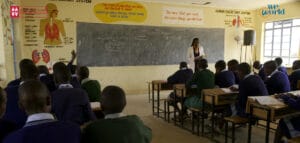
In the regions of Mykolaiv and Kherson, as part of the SMINA project - funded by the Italian Cooperation and implemented together with the local partner Peaceful Heaven of Kharkiv – we are carrying out educational activities on the risks posed by unexploded ordnance. These initiatives are currently reaching over 10,800 people, including both children and adults, through integrated interventions in education and protection services.
Activities for young children use age-appropriate methods: games, stories, songs, and interactive materials help them recognise dangers and adopt safe behaviours without instilling fear. At the same time, teachers, parents, and communities are engaged to reinforce the dissemination of accurate information and safe practices.
Alongside this educational work, humanitarian demining operations continue. In Ukraine today, women are increasingly involved in demining: around one-third of personnel are women - three times more than in 2021. They work daily to clear agricultural land, roads, and residential areas, helping to restore safety and access for communities.
"My name is Kateryna, I am 46 years old and I come from the city of Mykolaiv. In the morning, we get ready for work: we load our things into the car, arrive at the site, put on our personal protective equipment and face shields, grab our tools and the metal detector, and head to our working area.
Our protective gear consists of personal protective equipment (vest, helmet and gloves) and a face shield, as this protects us from shrapnel, whilst we carry tools such as a trowel, chisel and scraper so we can dig safely.
This is probably the biggest risk to our safety: we worry both for our own lives and for those of our colleagues. I really love this job and my colleagues. I enjoy clearing the land so that our farmers can sow their crops.
There are many women working in this sector. I believe the girls also want to help both the farmers and the villages clear all the land.
They’ve already got used to it; my family has already got used to the fact that I work as a deminer and help people. At first, they strongly advised me against taking up this profession, but I said I would work carefully and thatI wanted to help people.
I have two children. I told them I was going to become a deminer, and they took it well. They understand it’s dangerous, but at the same time they know it’s also a way of helping people. I think they’ve got used to it by now.
It’s the second year.
We all work on the same level. There’s no distinction between women and men here. Everyone does their job and treats each other equally." Kateryna, deminer in Mykolaiv.
Among them is Karina, a 20-year-old deminer working in Mykolaiv with partner organisation DCA – DanChurchAid. Her experience illustrates what it means to operate in contaminated environments, where danger is often invisible and unpredictable:
“At first, everything was quiet,” says Karina. “I was digging when I suddenly saw some fabric, a plastic bag, and then a green pouch. I immediately called my foreman. It turned out there were eight grenades and some ammunition inside. Someone had hidden them deliberately and had even left a mark on a tree. At first, my knees were shaking. The scariest thing is the unknown - when you don’t understand what’s in front of you or what might happen.”
Landmines and unexploded ordnance represent one of the most enduring legacies of conflict. Even after the war ends, their impact persists for years, restricting freedom of movement, access to education, and the ability to live safely.
“We will remember this war for a long time,” continues Piero Meda. “Landmines will continue to pose a threat even after the fighting has ended. That is why it is essential to work with children: they will grow up in a country where these risks are part of daily life, and they must have the tools to recognise and avoid them.”
The SMINA project is supported by the Italian Ministry of Foreign Affairs and International Cooperation through the Italian Agency for Development Cooperation. Through this initiative, we are working alongside local partners to reduce the risks posed by landmines and explosive remnants of war, while also promoting greater awareness within affected communities. Additional awareness-raising activities are supported by the Charity Fund of Intesa Sanpaolo.
On the occasion of the International Day for Mine Awareness (4 April), it is essential to strengthen our commitment to initiatives that prioritise the protection of civilians - especially children. Ensuring access to risk education, clear information, and mine clearance activities means protecting not only the present, but also the future.